Google Will Now Tell You When an Ad Was Made With AI — But There's a Catch
Google is adding a new layer of transparency to the ads you see across Search, YouTube, and Discover: a label that tells you whether the ad in front of you was built or touched up using generative AI.
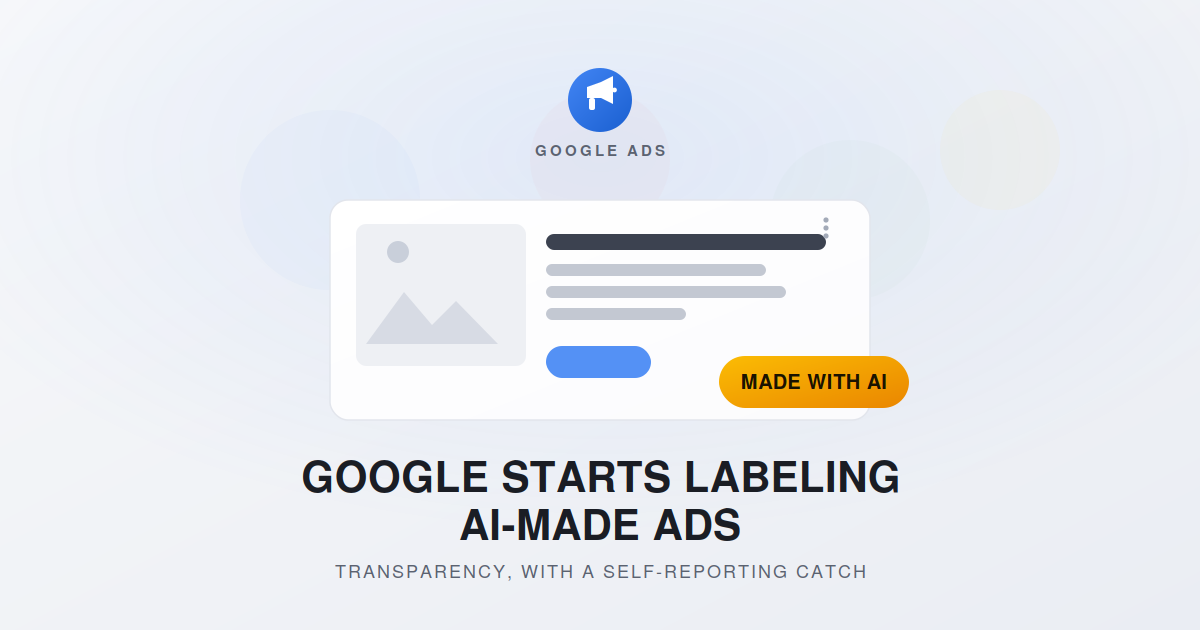
Google is adding a new layer of transparency to the ads you see across Search, YouTube, and Discover: a label that tells you whether the ad in front of you was built or touched up using generative AI.
Why This Is Happening Now
AI has quietly become a default part of ad production. Brands can now generate product shots, drop items into lifestyle scenes, and skip expensive photoshoots entirely — all with a text prompt. That's a genuine cost-saver for advertisers, but it creates a trust problem for everyone else: if a "product photo" was never actually photographed, shouldn't the person looking at it know that?
Until this update, Google only required that level of disclosure for one narrow category — election ads. Everything else, including AI-generated or AI-edited commercial content, could run without any indication that synthetic tools were involved, as long as it didn't cross into outright deceptive territory.
How the Feature Actually Works
The disclosure lives inside "My Ad Center," a panel most people don't know exists but have likely walked past dozens of times — it's accessible through the three-dot menu or info icon on ads across Google's properties. That panel already lets users block ads, report them, or see why a particular ad was targeted at them. Now it includes a new option: "how this ad was made," which reveals whether AI played a role in creating or editing it.
The Loophole Worth Knowing About
Here's the part that matters most: Google's disclosure is only automatic when advertisers build their ads using Google's own generative AI tools. If a brand creates an AI-generated ad somewhere else — say, with a third-party image generator — and then uploads it, the responsibility to flag that falls entirely on the advertiser. Google isn't scanning uploaded creative to detect AI involvement on its own. It's an honor-system disclosure for anything made outside Google's ecosystem, though some regions may still require labeling under local law regardless of what the advertiser chooses to disclose.
That distinction matters a lot in practice. Self-reported disclosure only works if advertisers actually opt in, and there's an obvious incentive not to — a hyper-realistic AI-generated product shot loses some of its impact the moment it's flagged as synthetic. Without an automated detection layer to backstop it, this feature is really a starting point for transparency rather than a guarantee of it.
The Bigger Picture
This move fits into a broader pattern playing out across the tech industry: platforms building disclosure tools for AI content faster than they're building ways to actually enforce them. Google's decision to expand this beyond election ads suggests the company sees synthetic ad content as common enough now to warrant its own dedicated label, not just an edge case tied to political sensitivity.
For everyday users, the practical upside is small but real — anyone curious enough to click the info icon on an ad can now get a straight answer about whether what they're looking at is real. Whether most people ever bother to check is a different question entirely.