OpenAI Rolls Out GPT-5.6, and This Time the Target Is Clearly Anthropic
OpenAI just dropped its next major model family, and unlike some of its past releases, this one comes with a very specific rival in its crosshairs.
OpenAI just dropped its next major model family, and unlike some of its past releases, this one comes with a very specific rival in its crosshairs.
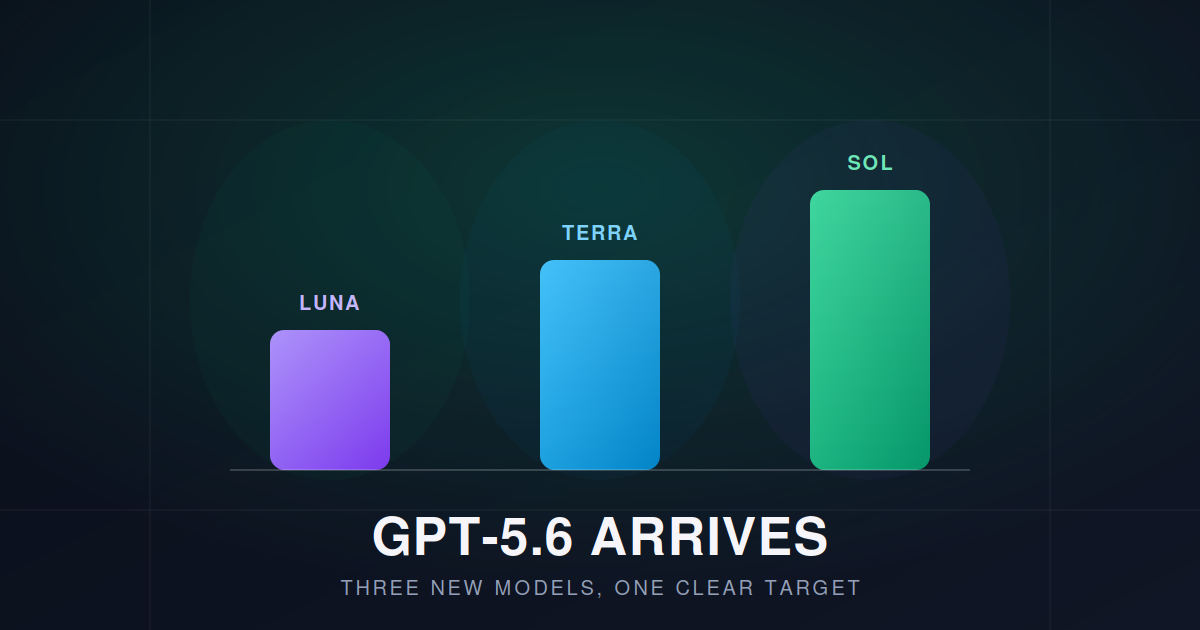
Announced Thursday, GPT-5.6 arrives not as a single model but as a trio, each aimed at a different budget and use case. Sol sits at the top as the flagship, built for heavy-duty coding and enterprise work. Terra is the mid-tier option, positioned for teams that need solid performance without paying flagship prices. And Luna rounds out the lineup as the cheap, lightweight option for simpler tasks. It's a familiar good-better-best structure, but the pitch behind it is anything but modest.
Cheaper, Faster, and Built to Prove a Point
CEO Sam Altman has been vocal about the efficiency gains baked into this release, telling CNBC that the flagship Sol model uses roughly half the tokens of its predecessor on coding tasks — a meaningful cost difference for developers and companies running these models at scale.
Efficiency claims aside, OpenAI is leaning hardest into a different angle this time: security. The company is branding 5.6 as its most capable cybersecurity model to date, one that can hit top-tier performance while burning through far fewer tokens than before. That's not a small detail — earlier this summer, the model's rollout ran into friction with U.S. officials, who reportedly pushed to slow its release over concerns about how its cyber capabilities might be misused. OpenAI says the model is built for defensive work: catching vulnerabilities, reviewing and patching code, and running simulated attacks against a company's own systems to find weak points before real attackers do.
Alongside the models, OpenAI also introduced ChatGPT Work, a workplace-focused companion app for desktop, web, and mobile. Think of it as an assistant built for the unglamorous parts of office life — putting together documents, building out spreadsheets, and drafting presentations — rather than a general-purpose chatbot.
The Real Story Is Who OpenAI Is Aiming At
Plenty of AI labs have shipped new models this week alone, including SpaceXAI and Meta. But the framing around GPT-5.6 makes it obvious which competitor OpenAI actually cares about beating: Anthropic.
Anthropic has spent the past year building a reputation as the scrappier, more trusted alternative in the AI race — leaning into enterprise relationships and picking up goodwill along the way. OpenAI's messaging around this release reads like a direct response to that momentum. The company points to the Artificial Analysis Coding Agent Index, a widely referenced benchmark for coding performance, to argue that its new lineup beats Anthropic's models across the board.
OpenAI is calling Sol its best coding model ever built, and the comparisons it's drawing are pointed. Measured against Anthropic's recently released Fable 5, OpenAI claims Sol posts a new top score on the benchmark — a few points higher than Fable 5 — while using less than half the output tokens, finishing in less than half the time, and costing roughly a third less. According to OpenAI, that pattern holds across the whole family: Terra edges out Fable 5, and even the budget-tier Luna reportedly outperforms Anthropic's Opus 4.8.
Those are OpenAI's numbers, worth noting, and benchmark comparisons in AI marketing tend to be cherry-picked to favor whoever's citing them. Still, the fact that OpenAI built its entire release narrative around beating a specific competitor, model for model, tells you a lot about how seriously it's taking Anthropic's rise.
Pricing and Availability
GPT-5.6 is live now across ChatGPT, Codex, and the OpenAI API. Pricing follows the expected tiered structure:
- Sol: $5 per million input tokens / $30 per million output tokens
- Terra: $2.50 per million input tokens / $15 per million output tokens
- Luna: $1 per million input tokens / $6 per million output tokens
For developers and teams already working inside the OpenAI ecosystem, that's a meaningful spread — Luna in particular looks aimed squarely at cost-sensitive projects and high-volume applications where every token matters.
What This Means Going Forward
Whether or not OpenAI's benchmark claims hold up under independent testing, the bigger takeaway is the shape of the competition itself. This isn't a market where one company is quietly iterating anymore — it's a public, model-by-model rivalry playing out in real time, with pricing, speed, and benchmark scores all being used as ammunition. For anyone building on top of these platforms, that's good news in the short term: faster iteration, more competitive pricing, and models pushed harder to prove their worth. The question worth watching is whether Anthropic responds with its own release, or lets the numbers speak on their own terms next time around.