
Microsoft, Google, Meta, and Amazon: How Big Tech Is Competing in the AI Race
Artificial intelligence has become the biggest competition in the technology industry. Microsoft, Google, Meta, and Amazon are no longer only competing in search, cloud computing, social media, or e-commerce.
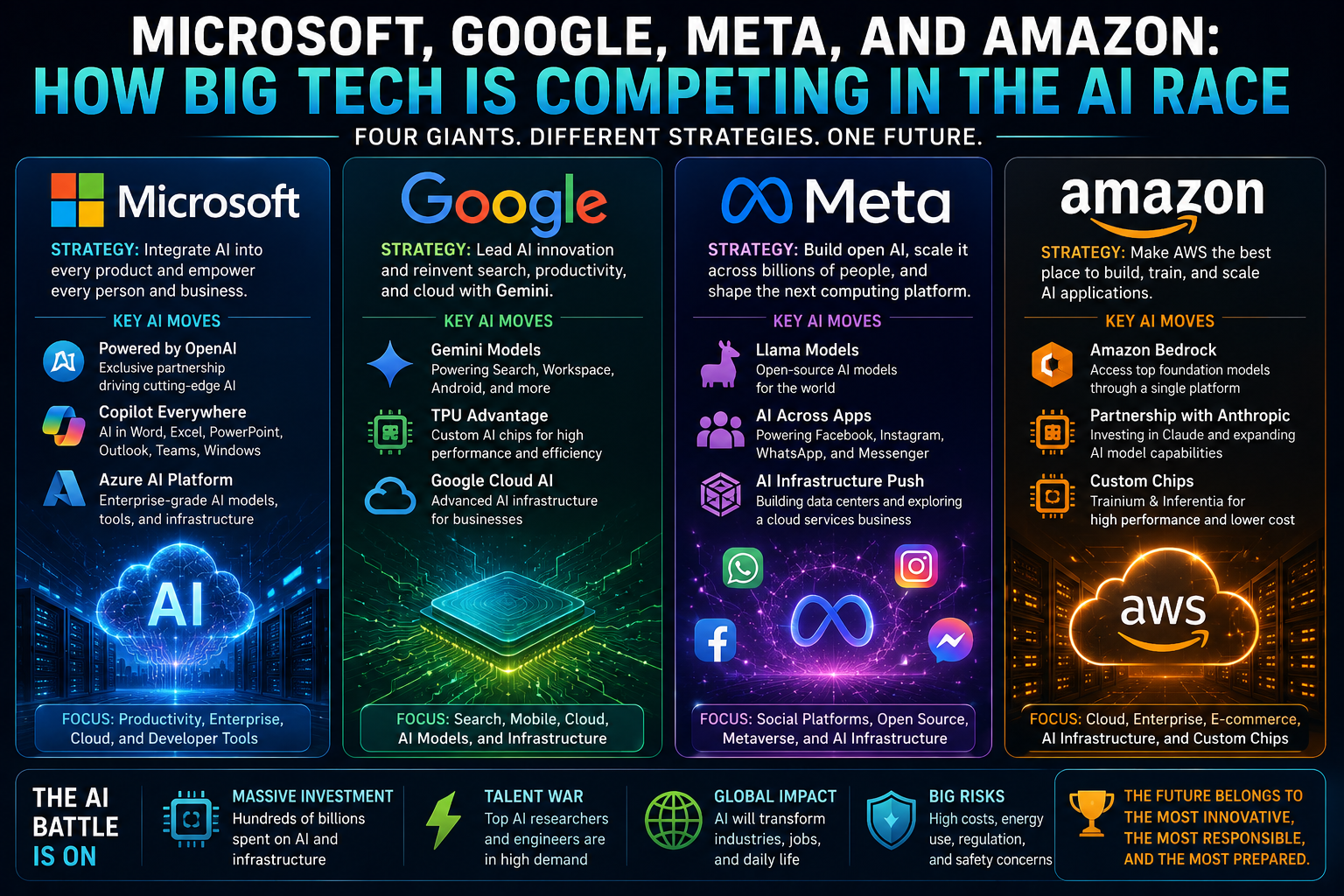
Artificial intelligence has become the biggest competition in the technology industry. Microsoft, Google, Meta, and Amazon are no longer only competing in search, cloud computing, social media, or e-commerce. In 2026, they are fighting for control of the AI future.
The AI race is not just about who can build the smartest chatbot. It is also about cloud infrastructure, data centers, AI chips, enterprise tools, open-source models, partnerships, and the ability to turn AI into real revenue. Each company has a different strategy, but all of them are investing heavily because they believe AI will define the next generation of technology.
As AI becomes part of work, business, search, entertainment, shopping, and communication, Big Tech companies are spending billions to secure their position. The competition is intense, expensive, and risky.
Why the AI Race Matters
The AI race matters because artificial intelligence is becoming the new foundation of the digital economy. Businesses are using AI to automate tasks, write content, analyze data, improve customer service, build apps, and make faster decisions. Consumers are using AI for search, learning, image generation, productivity, and personal assistance.
This shift creates a major opportunity for Big Tech. The company that controls the best AI tools, cloud platforms, and computing power can attract developers, businesses, advertisers, and everyday users.
But AI also requires massive infrastructure. Training and running advanced AI models needs powerful chips, huge data centers, electricity, cooling systems, and global networks. This is why Microsoft, Google, Meta, and Amazon are spending so much money. Reports in 2026 show that the biggest hyperscalers are dramatically increasing capital spending to support AI infrastructure, with estimates reaching hundreds of billions of dollars in one year.
Microsoft: Betting Big on OpenAI and Azure
Microsoft has one of the strongest positions in the AI race because of its partnership with OpenAI. OpenAI’s technology powers many of Microsoft’s AI products, including Copilot tools across Microsoft 365, Windows, GitHub, and Azure.
Microsoft’s strategy is clear: bring AI into the software millions of people already use. Instead of making AI a separate product, Microsoft is adding AI directly into Word, Excel, Outlook, Teams, Windows, and developer tools. This gives Microsoft a major advantage in the workplace because many companies already depend on its software.
Azure is also a key part of Microsoft’s AI strategy. OpenAI’s first-party products continue to be hosted on Azure, according to a 2026 joint statement from OpenAI and Microsoft. This means Microsoft benefits not only from selling AI tools, but also from providing the cloud infrastructure behind them.
However, Microsoft also faces challenges. AI infrastructure is expensive, and the company must prove that AI revenue can grow fast enough to justify its huge spending. Investors are watching closely to see whether Copilot, Azure AI, and OpenAI-related services can become long-term profit engines.
Google: Defending Search and Building Gemini
Google is one of the most important AI companies in the world. It has been investing in artificial intelligence for many years, and its DeepMind division is known for major AI research breakthroughs. But the rise of ChatGPT and other AI tools created pressure on Google’s biggest business: search.
Google’s main AI product family is Gemini. The company is using Gemini across search, Android, Workspace, Google Cloud, and developer tools. Its goal is to make AI available everywhere inside the Google ecosystem.
Google also has a powerful advantage in AI infrastructure because it builds its own Tensor Processing Units, or TPUs. At Google Cloud Next 2026, Google announced new AI infrastructure capabilities, including updates designed for the “agentic” AI era, where AI systems can reason and take action.
This gives Google a different position from companies that rely more heavily on outside chip suppliers. By designing its own AI chips, Google can optimize performance, cost, and energy efficiency for its own models and cloud customers.
Google’s challenge is balancing innovation with protection of its search advertising business. AI answers can change how people use search. If users get direct answers instead of clicking links, the traditional search model may be disrupted. Google must lead in AI without damaging the business that made it one of the most profitable companies in history.
Meta: Open-Source AI and Social Media Scale
Meta is taking a different path in the AI race. While Microsoft and Google focus heavily on enterprise software and cloud services, Meta is using AI across Facebook, Instagram, WhatsApp, Messenger, and its advertising systems.
Meta’s biggest AI advantage is scale. Billions of people use its platforms. This gives Meta a massive distribution channel for AI assistants, recommendation systems, content tools, and advertising products.
Meta is also known for its Llama family of open AI models. By releasing powerful open models, Meta has positioned itself as a major force in open-source AI. This strategy helps developers, startups, and researchers build on Meta’s technology, which can increase Meta’s influence in the AI ecosystem.
In 2026, Meta is also reportedly exploring a cloud infrastructure business that could sell access to AI computing power and models, putting it into more direct competition with Amazon, Microsoft, and Google. This would be a major shift because Meta has traditionally not been a public cloud provider like AWS, Azure, or Google Cloud.
Meta’s challenge is cost. Building AI infrastructure is extremely expensive. Some reports suggest Meta is spending heavily on data centers and AI compute, creating pressure to generate new revenue streams from AI.
Amazon: AWS, Bedrock, and Anthropic
Amazon’s strongest AI weapon is AWS, the world’s leading cloud platform. Many businesses already use Amazon Web Services to run apps, store data, and manage infrastructure. Now AWS wants to become the platform companies use to build and deploy AI.
Amazon’s AI strategy is focused on enterprise customers. Through Amazon Bedrock, businesses can access foundation models from different providers and build AI applications without managing the underlying infrastructure. This gives customers flexibility and keeps AWS central to their AI workflows.
Amazon also has a major partnership with Anthropic, the company behind Claude. In 2026, Anthropic announced an expanded collaboration with Amazon that includes up to 5 gigawatts of capacity for training and deploying Claude, including Trainium2 and Trainium3 infrastructure. AWS also said Anthropic is training advanced foundation models on AWS Trainium and Graviton infrastructure.
This is important because Amazon wants to compete not only through cloud services, but also through its own custom AI chips. Trainium and Inferentia are designed to reduce dependence on expensive third-party GPUs and give AWS customers more cost-efficient AI options.
Amazon’s challenge is visibility. While Microsoft has OpenAI, Google has Gemini, and Meta has Llama, Amazon is often seen as less consumer-facing in AI. But in enterprise AI infrastructure, AWS remains a powerful competitor.
The AI Race Is Also a Spending Race
One of the biggest stories in 2026 is how expensive AI competition has become. Microsoft, Google, Meta, and Amazon are all spending heavily on data centers, chips, networking, power, and cloud infrastructure.
This spending is creating concern among investors. Reuters warned that the AI investment boom may carry the risk of overinvestment, especially if every major player assumes it can win at the same time. The Wall Street Journal also reported that AI capital spending among major tech companies has surged sharply, raising questions about whether companies can earn strong returns from such massive investments.
The risk is simple: AI infrastructure costs are rising faster than proven AI profits. Big Tech believes demand will continue growing, but if customers do not pay enough for AI services, some companies may struggle to justify the scale of their investments.
Energy and Climate Pressure
The AI race is also creating a power and climate challenge. AI data centers consume huge amounts of electricity, and major tech companies are facing pressure over emissions and energy use. Recent reports have highlighted that Google, Amazon, Microsoft, and Meta are struggling to balance AI infrastructure growth with climate goals.
This means the AI race is not only about software. It is also about energy supply, renewable power, efficient chips, cooling systems, and sustainable data center design. Companies that solve the energy problem may gain a major advantage.
Who Is Winning the AI Race?
There is no single winner yet. Microsoft leads in enterprise AI adoption through OpenAI and Copilot. Google has deep AI research, Gemini, search distribution, and custom TPUs. Meta has open-source AI, social media scale, and a growing AI infrastructure strategy. Amazon has AWS, Bedrock, Anthropic, and custom AI chips.
The real winner may be the company that can combine three things: powerful AI models, affordable infrastructure, and a clear business model.
AI hype alone is not enough. Big Tech must prove that AI can generate sustainable revenue, improve productivity, reduce costs, and deliver real value to users and businesses.
Final Thoughts
Microsoft, Google, Meta, and Amazon are competing in one of the most important technology races of this generation. The AI race will shape the future of cloud computing, search, productivity, advertising, social media, and digital services.
Each company has a different path. Microsoft is using OpenAI and Copilot to dominate workplace AI. Google is defending search while expanding Gemini and TPU infrastructure. Meta is pushing open-source AI and using its social platforms for distribution. Amazon is using AWS, Bedrock, Anthropic, and custom chips to power enterprise AI.
The competition is far from over. In fact, 2026 may only be the beginning. The next phase of the AI race will be decided not only by who builds the smartest model, but by who can scale AI responsibly, profitably, and sustainably.