
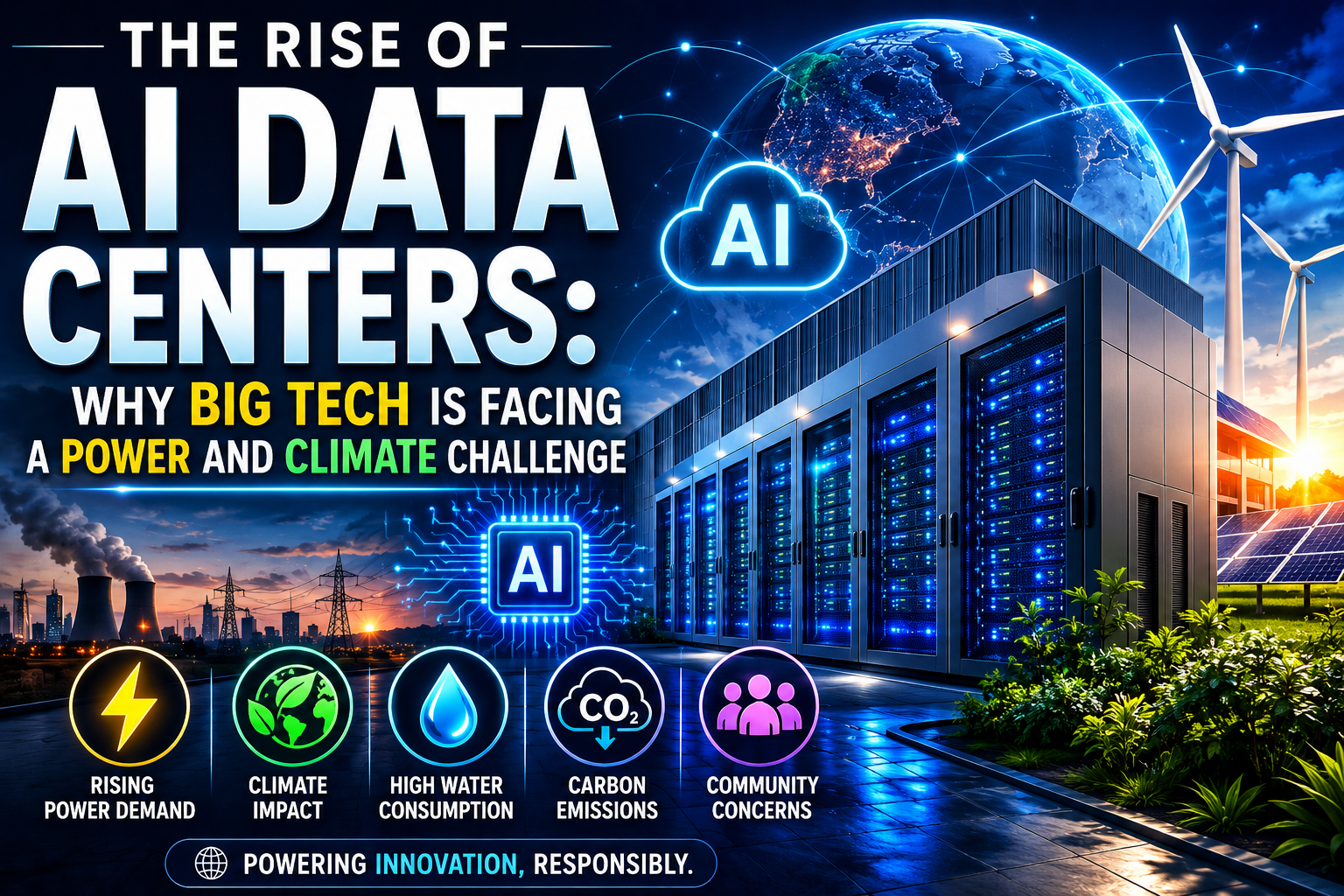
The Rise of AI Data Centers: Why Big Tech Is Facing a Power and Climate Challenge
Artificial intelligence is changing the technology industry faster than almost any trend before it.
Artificial intelligence is changing the technology industry faster than almost any trend before it. From AI chatbots and image generators to coding assistants, search tools, robotics, and business automation, AI is becoming part of daily life. But behind every AI response, every generated image, and every automated task, there is a massive physical infrastructure working in the background: AI data centers.
These data centers are the hidden engines of the AI revolution. They are filled with powerful servers, advanced chips, cooling systems, networking equipment, and storage machines. They process the enormous amount of data needed to train and run AI models. However, as demand for AI grows, Big Tech companies are facing a serious challenge: AI data centers require huge amounts of electricity, water, land, and cooling power.
In 2026, the rise of AI data centers has become more than a technology story. It is now an energy, climate, business, and infrastructure issue.
What Are AI Data Centers?
AI data centers are specialized facilities designed to support artificial intelligence workloads. Unlike traditional data centers that mainly handle websites, cloud storage, emails, and business applications, AI data centers are built for heavy computing tasks.
Training large AI models requires thousands of powerful chips working together for long periods. Running AI services also requires constant computing power because millions of users may send prompts, generate images, summarize documents, or use AI agents at the same time.
This means AI data centers need more power than many older data centers. They also produce more heat, which requires advanced cooling systems. As AI becomes more popular, companies such as Microsoft, Google, Amazon, Meta, and other cloud providers are investing billions of dollars to build larger and more powerful facilities.
Why AI Data Centers Are Growing So Fast
The main reason AI data centers are expanding is simple: demand for AI is exploding. Businesses want AI tools to improve productivity. Developers want AI coding assistants. Consumers want AI search, AI images, AI videos, and AI personal assistants. Startups need cloud infrastructure to build new AI products.
At the same time, AI models are becoming more advanced. New models require more computing power, more memory, and faster chips. This creates a cycle where better AI needs bigger infrastructure, and bigger infrastructure creates more demand for energy.
The International Energy Agency has warned that global electricity consumption from data centers is expected to roughly double from around 485 TWh in 2025 to about 950 TWh in 2030, equal to around 3% of global electricity demand by that date. AI-focused data centers are expected to grow even faster than the overall data center sector.
The Power Problem Behind AI
Electricity is now one of the biggest challenges facing the AI industry. AI data centers need stable, high-capacity power 24 hours a day. They cannot depend on weak grids or unreliable energy supply because downtime can affect millions of users and business customers.
According to the IEA, electricity demand from data centers increased sharply in 2025, while demand from AI-focused data centers grew even faster than the overall sector. The IEA reported that data center electricity demand rose by 17% in 2025, compared with global electricity demand growth of around 3%.
This creates pressure on national and local power grids. In some regions, data center growth is becoming so large that utilities must upgrade transmission lines, build new substations, and secure additional electricity generation. In the United States, the IEA has projected that data centers could account for about half of electricity demand growth through 2030.
For Big Tech, this is a major business issue. Companies can build AI models and buy chips, but if they cannot secure enough electricity, they cannot scale their AI services as fast as they want.
The Climate Challenge
The power problem also creates a climate challenge. Many major technology companies have promised to reduce emissions, use renewable energy, or reach net-zero targets. But the rapid expansion of AI data centers is making those goals harder to achieve.
Data centers can be powered by renewable energy, but renewable supply is not always available at the exact time and location needed. When demand grows faster than clean power infrastructure, companies may still depend on grids that use natural gas, coal, or other fossil fuels.
The IEA projects that emissions from electricity used by data centers could rise from about 180 million tonnes today to 300 million tonnes by 2035 in its base case, and even higher under more aggressive AI growth scenarios.
Recent reporting has also shown that the AI boom is putting pressure on the climate goals of major tech companies, as emissions linked to infrastructure growth continue to rise despite large investments in clean energy.
This is the difficult reality of the AI race. The same companies promoting AI as a tool for efficiency and innovation are also building energy-hungry infrastructure that can increase carbon emissions if not managed carefully.
Water Use Is Another Concern
Electricity is not the only issue. Many data centers also use large amounts of water for cooling. Servers generate heat, and cooling systems are needed to keep equipment running safely. In hot regions or areas with limited water supply, this can create tension with local communities.
Amazon reported that its global data centers used 2.5 billion gallons of water in 2025, while also saying it has improved water efficiency and is working toward becoming “water positive” by 2030.
Water use is becoming a sensitive topic because many data centers are built near cities, farms, or communities that already worry about water availability. As AI workloads grow, the industry will need to improve cooling systems, reuse water, and build more efficient facilities.
Local Communities Are Pushing Back
AI data centers are often presented as signs of economic progress. They can bring investment, construction jobs, tax revenue, and digital infrastructure. But not every community welcomes them.
Some residents worry about higher electricity bills, water usage, land development, noise, and environmental impact. In areas where many data centers are built close together, local grids can become stressed. Some projects have already faced delays, legal challenges, or community opposition.
A 2026 report highlighted that many large data center projects are at risk of delay or cancellation due to power constraints, community resistance, environmental concerns, and supply chain problems.
This shows that the future of AI is not only about software. It also depends on planning approvals, electricity supply, land use, and local public trust.
Why Big Tech Is Investing Anyway
Despite the challenges, Big Tech is not slowing down. AI is now seen as the next major platform shift after the internet, smartphones, and cloud computing. Companies that control AI infrastructure can sell cloud services, AI tools, enterprise software, search products, and automation platforms.
For Microsoft, Amazon, Google, and Meta, AI data centers are not optional. They are the foundation of future growth. Without massive computing power, these companies cannot compete in AI models, cloud platforms, AI assistants, and business automation.
This is why Big Tech is investing heavily in chips, energy contracts, renewable power, nuclear energy discussions, battery storage, and more efficient cooling. The companies know that the winners of the AI race may be the ones that can secure the most reliable and cost-effective computing infrastructure.
Possible Solutions
There is no single solution to the AI data center problem, but several steps can reduce the pressure.
First, companies need more renewable energy. Solar, wind, geothermal, hydro, and nuclear power can help reduce emissions if they are added fast enough and matched with storage and grid upgrades.
Second, AI chips must become more efficient. Better hardware can reduce the electricity needed for each AI task. However, efficiency alone may not solve the problem if total AI usage keeps growing.
Third, data centers need smarter cooling. Liquid cooling, recycled water, air cooling improvements, and heat reuse systems can reduce water and energy waste.
Fourth, governments and utilities need better planning. Data center growth should be coordinated with grid capacity, clean energy supply, and local community needs.
Finally, AI companies should be more transparent. Public reporting on electricity use, emissions, water use, and local impact can help build trust and encourage responsible growth. The IEA has recommended that data center and network operators report energy use and sustainability indicators such as emissions and water use.
The Future of AI Depends on Energy
The rise of AI data centers proves that the digital world is not weightless. Every AI tool depends on real buildings, real power lines, real cooling systems, and real natural resources.
AI may help businesses become more productive, improve healthcare, support education, and create new technology. But the industry must also face the environmental cost of its growth. If Big Tech wants AI to become a trusted part of the future, it must prove that AI infrastructure can scale without damaging climate goals or overwhelming local communities.
In 2026, the AI race is no longer only about who has the smartest model. It is also about who can build the most sustainable, efficient, and responsible data centers.
The future of artificial intelligence will be shaped not just by algorithms, but by electricity, water, climate policy, and the ability of Big Tech to balance innovation with responsibility.